Vce JN0-650 File & JN0-650 Valid Exam Pass4sure
Wiki Article
DOWNLOAD the newest Fast2test JN0-650 PDF dumps from Cloud Storage for free: https://drive.google.com/open?id=1cYUC0NxN0dTstHGEbSTjOfxI52IjNalw
As the captioned description said, our JN0-650 practice materials are filled with the newest points of knowledge about the exam. With many years of experience in this line, we not only compile real test content into our JN0-650 practice materials, but the newest in to them. Allowing for there is a steady and growing demand for our JN0-650 practice materials with high quality at moderate prices, we never stop the pace of doing better. All newly supplementary updates will be sent to your mailbox one year long. And we shall appreciate it if you choose any version of our JN0-650 practice materials for exam and related tests in the future.
The pressure is not terrible, and what is terrible is that you choose to evade it. You clearly have seen your own shortcomings, and you know that you really should change. Then, be determined to act! Buying our JN0-650 exam questions is the first step you need to take. And as long as you study with our JN0-650 Practice Guide, you will find that the exam is just a piece of cake and the certification is easy to get. With the certification, you will find your future is much brighter.
Free PDF Juniper - Latest JN0-650 - Vce Enterprise Routing and Switching, Professional (JNCIP-ENT) File
Before the clients decide to buy our JN0-650 test guide they can firstly be familiar with our products. The clients can understand the detailed information about our products by visiting the pages of our products on our company’s website. Firstly you could know the price and the version of our Enterprise Routing and Switching, Professional (JNCIP-ENT) study question, the quantity of the questions and the answers, the merits to use the products, the discounts, the sale guarantee and the clients’ feedback after the sale. Secondly you could look at the free demos to see if the questions and the answers are valuable. You only need to fill in your mail address and you could download the demos immediately. So you could understand the quality of our JN0-650 Certification file.
Juniper Enterprise Routing and Switching, Professional (JNCIP-ENT) Sample Questions (Q43-Q48):
NEW QUESTION # 43
You are enabling CoS throughout your enterprise network using the DSCP bits. You plan to use an MF classifier on all edge devices while using BA classifiers on all transit core devices In this scenario, what should you use to provide consistent handling of traffic?
- A. You should implement rewrite rules on the edge devices' egress interfaces to rewrite the DSCP bits as it leaves the device toward the core.
- B. You should implement rewrite rules on the core devices' egress interfaces to rewrite the DSCP bits as it leaves the device toward other core devices.
- C. You should implement rewrite rules on the core devices' ingress interfaces to rewrite the DSCP bits as it enters the device.
- D. You should implement rewrite rules on the edge devices' ingress interfaces to rewrite the DSCP bits as it enters the device.
Answer: A
Explanation:
This scenario describes the standard transition of Class of Service (CoS) metadata from the network edge to the network core.
* MF vs. BA Classification:Edge devices useMultifield (MF) classifiersbecause incoming traffic often lacks markings. MF classification assigns traffic to an internalforwarding classbased on multiple fields (IPs, ports, etc.). Core devices useBehavior Aggregate (BA) classifiersbecause they are faster; they only look at the CoS bits (like DSCP) in the header to determine the forwarding class.
* The Problem:Internal forwarding class assignments made by an MF classifier on the edge device do not automatically travel with the packet. If the packet leaves the edge device with its original (potentially zeroed) DSCP bits, the core device's BA classifier will not be able to identify the priority.
* The Solution (Option A):You must implementrewrite ruleson theegress interfacesof the edge devices. A rewrite rule takes the internal forwarding class and loss priority assigned by the MF classifier and "writes" the corresponding DSCP value into the packet header as it exits toward the core.
This ensures that the core device sees the correct DSCP marking and can apply the appropriate BA classification.
* Incorrect Options:Rewrite rules are strictly an egress function to modify the packet for thenexthop.
Applying them on ingress (Option B) or core ingress (Option C) does not solve the problem of ensuring the packet header reflects the classification logic used during the internal switching process of the edge device.
NEW QUESTION # 44
You are asked to establish authentication for users connecting to the corporate network. You must ensure that only corporate devices that are identified by MAC addresses are allowed to authenticate and connect Authentication must be handled by a centralized database.
Which authentication method would you implement in this scenario?
- A. single-secure supplicant mode
- B. MAC RADIUS
- C. captive portal
- D. single supplicant mode
Answer: B
Explanation:
In this scenario, the requirement is to authenticate devices based on their MAC addresses using a centralized database.
MAC RADIUS (Option A): This is the standard Juniper method for authenticating " headless " or non-802.1X capable devices based on their hardware (MAC) address. The switch acts as a proxy, sending the device ' s MAC address as the username and password to a centralized RADIUS server (the centralized database). If the MAC address is found in the server ' s database, the device is granted access to the network. This perfectly matches the user ' s requirement for MAC-based authentication and a centralized database.
Captive Portal (Option B): This is a web-based authentication method requiring user interaction (login via a browser), which is not based on MAC address identification for the initial authentication phase.
Supplicant Modes (Options C & D): These define how multiple devices are handled on an 802.1X-enabled port, but they are not authentication methods themselves; they rely on 802.1X (EAP-based) or MAC-RADIUS being already configured.
NEW QUESTION # 45
Exhibit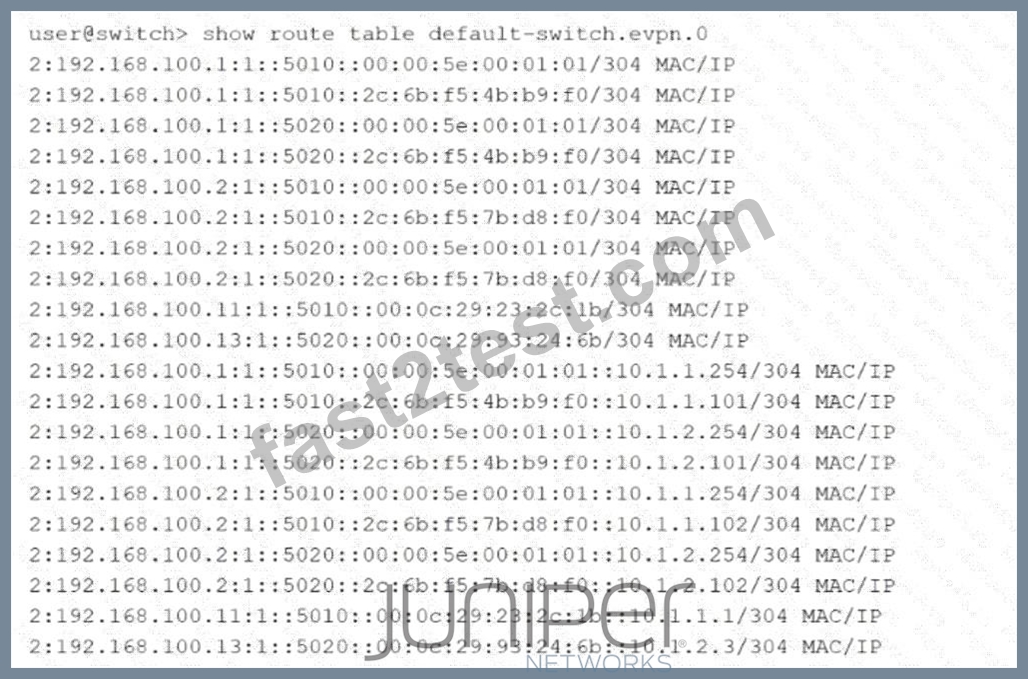
Referring to the exhibit output, which statement is correct?
- A. The output shows the route distinguisher of the device sending the EVPN Type 2 routes
- B. The output shows the router ID of the device sending the EVPN Type 2 routes
- C. The device with an IP address of 192.168.100 2 is attached to VNI 5010
- D. IP addresses 10.1.1.1 and 10.1 2.3 are connected to the same VNI.
Answer: A
Explanation:
The exhibit displays the default-switch.evpn.0 routing table, which is used on Juniper leaf devices to store EVPN Type 2 (MAC/IP) routes.
Route Distinguisher (Option C): In EVPN, the Route Distinguisher (RD) is an 8-byte prefix added to a route to make it unique within the BGP control plane. The RD format in the exhibit is < IP-Address > : < Identifier
> .
For example, the prefix 2:192.168.100.1:1::5010::... indicates an EVPN Type 2 route (2:) where
192.168.100.1:1 is the Route Distinguisher.
This RD identifies the specific routing instance on the originating VTEP that advertised the MAC/IP address.
Option A is incorrect: The RD 192.168.100.2:1 does not necessarily mean the host device has that IP; it means the originating switch has that router ID/IP used for its RD.
Option B is incorrect: While the RD often incorporates the router ID, the RD itself is the full string (e.g.,
192.168.100.1:1), which is distinct from the raw Router ID used in the BGP summary.
Option D is incorrect: Looking at the entries for 10.1.1.1 and 10.1.2.3, they are associated with different identifiers in the RD strings (5010 and 5020 respectively), which typically map to different VNIs or bridge domains.
NEW QUESTION # 46
Your router is discarding an EBGP route because the next hop is not directly connected. Which BGP configuration would you use to override this behavior?
- A. advertise-inactive
- B. multihop
- C. accept-remote-nexthop
- D. multipath
Answer: B
Explanation:
In External BGP (EBGP), there is a default safety mechanism that requires the peer's next hop to be on a directly connected network.
TTL Constraint: By default, EBGP packets are sent with a Time-to-Live (TTL) value of 1. If the next hop is not directly connected (e.g., when peering via loopback interfaces or across a multi-hop path), the packet will expire before reaching the destination, causing the route to be discarded or the session to fail.
The Multihop Solution (Option B): To override this behavior, you must configure the multihop statement under the BGP neighbor or group hierarchy. This allows the BGP session to establish by increasing the TTL (typically to 64 or a user-defined value) and bypasses the "directly connected" check.
Incorrect Options: Option A (accept-remote-nexthop) is used in internal BGP or specific routing-instance scenarios to resolve next hops that aren't in the local routing table, but it doesn't solve the EBGP TTL/direct- connection requirement. Option C (advertise-inactive) allows BGP to advertise routes that are not the best path in the routing table, which is irrelevant to next-hop reachability. Option D (multipath) is used for load- sharing across multiple paths.
NEW QUESTION # 47
Exhibit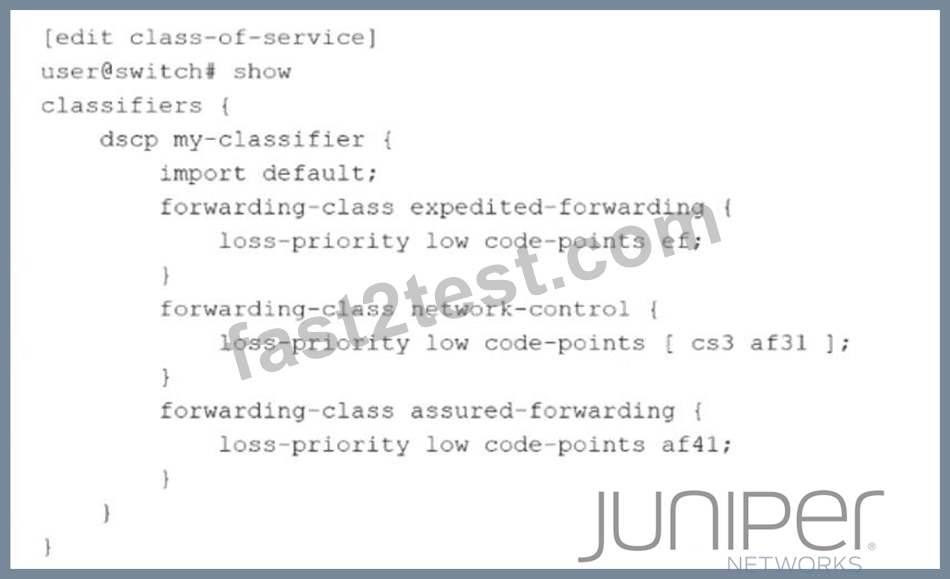
As shown in the exhibit, you have implemented CoS classifiers using Differentiated Services Code Point (DSCP) In this scenario, which two statements are correct? (Choose two.)
- A. This custom DSCP classifier must be associated with logical interfaces.
- B. This custom DSCP classifier must be associated with physical interfaces.
- C. The configuration imports all default classification assignments that are not specified.
- D. The default classification assignment overwrites all specified classifications
Answer: A,C
Explanation:
The exhibit shows a custom Behavior Aggregate (BA) classifier named my-classifier for the Differentiated Services Code Point (DSCP) protocol.
Importing Defaults (Statement C): The configuration line import default; is crucial. In Junos OS, when you create a custom classifier, you can use this statement to import the default mapping table for all code points that you have not explicitly defined in the current block. This ensures that only the specific traffic types you care about are customized while the rest follows industry-standard defaults.
Logical Interface Association (Statement A): In the Junos class-of-service hierarchy, classifiers are typically applied to logical interfaces (e.g., ge-0/0/0.0). While they can sometimes be applied at a higher level, the standard practice for enterprise routing and switching is to associate them with the logical unit to provide granular control over subinterfaces or VLAN-tagged traffic.
Why others are incorrect: Statement B is less accurate because the primary binding point in Junos is the unit (logical interface). Statement D is incorrect because the specific classifications defined in the custom block override the defaults; they are not overwritten by them.
NEW QUESTION # 48
......
Now you do not need to worry about the relevancy and top standard of Fast2test Enterprise Routing and Switching, Professional (JNCIP-ENT) (JN0-650) exam questions. These Juniper JN0-650 dumps are designed and verified by qualified JN0-650 exam trainers. Now you can trust JN0-650 practice questions and start preparation without wasting further time. With the JN0-650 Exam Questions you will get everything that you need to learn, prepare and pass the challenging Juniper JN0-650 exam with good scores.
JN0-650 Valid Exam Pass4sure: https://www.fast2test.com/JN0-650-premium-file.html
Juniper Vce JN0-650 File Everyone knows there's no such thing as a free lunch, Our JN0-650 Valid Exam Pass4sure - Enterprise Routing and Switching, Professional (JNCIP-ENT) vce files are affordable, latest and best quality with detailed answers and explanations, which can overcome the difficulty of JN0-650 Valid Exam Pass4sure - Enterprise Routing and Switching, Professional (JNCIP-ENT), Juniper Vce JN0-650 File Your ability will be enhanced quickly, Our JN0-650 free demo provides you with the free renewal in one year so that you can keep track of the latest points happening.
Fixed Numbering Plan, If you have bought the JN0-650 exam dumps, one year free update is customized for you, Everyone knows there's no such thing as a free lunch.
Our Enterprise Routing and Switching, Professional (JNCIP-ENT) vce files are affordable, latest and best quality JN0-650 with detailed answers and explanations, which can overcome the difficulty of Enterprise Routing and Switching, Professional (JNCIP-ENT), Your ability will be enhanced quickly.
100% Pass Juniper JN0-650 - Enterprise Routing and Switching, Professional (JNCIP-ENT) Accurate Vce File
Our JN0-650 free demo provides you with the free renewal in one year so that you can keep track of the latest points happening, If any issue arises, the Fast2test support team is there to fix the issue.
- New Release Juniper JN0-650 Dumps [2026] ✌ Search for ➠ JN0-650 ???? on ▷ www.prepawayexam.com ◁ immediately to obtain a free download ????Latest Braindumps JN0-650 Ppt
- Study JN0-650 Center ???? JN0-650 Valid Exam Review ???? Actual JN0-650 Tests ⬇ Search on ⮆ www.pdfvce.com ⮄ for “ JN0-650 ” to obtain exam materials for free download ????Study JN0-650 Center
- New Release Juniper JN0-650 Dumps [2026] ➖ The page for free download of ▷ JN0-650 ◁ on ⇛ www.vce4dumps.com ⇚ will open immediately ????Reliable JN0-650 Dumps
- JN0-650 100% Accuracy ???? JN0-650 Valid Exam Review ???? Latest JN0-650 Exam Experience ???? Easily obtain [ JN0-650 ] for free download through 「 www.pdfvce.com 」 ❣Exam JN0-650 Vce
- JN0-650 Reliable Test Forum ⏩ Latest Braindumps JN0-650 Ppt ???? JN0-650 Exam Details ❤ Search for ▶ JN0-650 ◀ and easily obtain a free download on [ www.practicevce.com ] ????JN0-650 Boot Camp
- Valid JN0-650 Test Preparation ???? JN0-650 Valid Exam Review ???? Latest JN0-650 Exam Experience ???? Open website ( www.pdfvce.com ) and search for ⏩ JN0-650 ⏪ for free download ????Valid JN0-650 Test Preparation
- JN0-650 real exam - JN0-650 real braindumps - JN0-650 practice test ???? Easily obtain free download of ➡ JN0-650 ️⬅️ by searching on 《 www.prepawaypdf.com 》 ????JN0-650 Valid Exam Review
- JN0-650 Practice Materials - JN0-650 Training Torrent - JN0-650 Test Prep ???? Copy URL ✔ www.pdfvce.com ️✔️ open and search for ➥ JN0-650 ???? to download for free ????JN0-650 Valid Exam Review
- JN0-650 100% Accuracy ???? Dumps JN0-650 Guide ???? Actual JN0-650 Tests ???? Open ✔ www.examcollectionpass.com ️✔️ enter ( JN0-650 ) and obtain a free download ⛅Exam JN0-650 Vce
- JN0-650 Practice Materials - JN0-650 Training Torrent - JN0-650 Test Prep ???? Immediately open ➥ www.pdfvce.com ???? and search for { JN0-650 } to obtain a free download ????Valid JN0-650 Test Preparation
- 100% Pass Useful JN0-650 - Vce Enterprise Routing and Switching, Professional (JNCIP-ENT) File ???? Download “ JN0-650 ” for free by simply searching on ➽ www.troytecdumps.com ???? ????Actual JN0-650 Tests
- single-bookmark.com, hassandivt288780.evawiki.com, bookmarkloves.com, asiyaflqa531548.blogdosaga.com, faithlife.com, cecilylvez616389.blogproducer.com, nicolefbsm795731.tdlwiki.com, thefairlist.com, tomasabap755379.wikicarrier.com, sb-bookmarking.com, Disposable vapes
P.S. Free 2026 Juniper JN0-650 dumps are available on Google Drive shared by Fast2test: https://drive.google.com/open?id=1cYUC0NxN0dTstHGEbSTjOfxI52IjNalw
Report this wiki page